Introduction to Vertical Greening Systems
1. Introduction
1.1. The benefits of vertical greening
Urban green infrastructure is the network of green spaces, water and other natural features within urban areas. A green infrastructure approach uses natural processes to deliver multiple functions, such as reducing the risk of flooding and cooling high urban temperatures. Urban green infrastructure includes parks, cemeteries, playing fields, private gardens, allotments, green roofs, green facades and living walls [1, 2, 3]. Whereas roofs are not always a visible feature, especially in the inner city, we are constantly aware of and guided by the presence of walls in our towns and cities. Many of these are often blank and featureless, and provide an opportunity for creating living walls. Living walls utilise plants to derive benefits not only in visual terms, but also with regards to amenity, biodiversity, thermal efficiency and amelioration of pollutants, all for a very small ground level footprint [
Health and wellbeing benefits
Green spaces can improve mental health and the quality of community life. Researchers have observed a link between increasing urbanisation and psychosis or depression. Experimental evidence suggests that simply having views of nature can improve mood, self-esteem and concentration, and help to treat stress and mental health disorders. These benefits have been shown to occur over very short exposure periods to vegetation.
Living walls provide visual amenity, resulting in a green and organic skin to what otherwise may be a ‘cold’ and unattractive wall. In some cases architects may contest that such a living wall will detract from the overall aesthetic of the building. Clearly, living walls have to be designed so as to contribute aesthetically not only to the building itself but to the overall environment in which it sits. The involvement of architects, landscape architects and ecologists at the earliest possible stage in the design process is critical in achieving the greatest visual amenity advantage.
Environmental benefits
Air pollution tends to be highest in deprived urban areas, and particulate air pollution (PM10) is a major health issue in cities around the world. Motor vehicle exhaust emissions are responsible for a substantial proportion of urban particulates and their reduction presents the largest challenge to improving the air quality. Exposure to high air pollution can cause and exacerbate respiratory problems, heart disease and cancer. Green infrastructure can reduce exposure in two ways.
- Vegetation can reduce air pollution directly by trapping and removing fine particulate matter and indirectly by reducing air temperatures. The strength of the effect depends on multiple factors, such as the weather, the pollution concentration, and the type and quality of vegetation.
- Urban transport infrastructure often results in the funnelling of pedestrians along major roads, where the concentration of air pollution is highest. Green corridors across cities can reduce pedestrian exposure to pollution by providing alternative routes.
Living walls can trap dust and other pollutants from both the air and rainfall on the leaves of plants, though during sustained periods of dry weather plants may reach a saturation point, after which particulate capture is likely to become less efficient. Varying the type, location and density of plants within a living wall can increase the opportunities for particulate capture. Creating texture across the wall by using a variety of plants increases the air turbulence in and around the vegetation, which has been shown to increase the rate of particulate deposition. The particulate capture ability of different plant species depends on the size, shape and surface texture of the leaves:
- Hairy, rough and/or ridged leaves are effective in trapping particles
- Waxy leaves are also effective in trapping particles
- Plants that attract aphids could be appropriate for inclusion as the sticky secretion of aphids deposited on leaves will retain particles
- Evergreen vegetation offers a year-round particulate-trapping surface
- Plants with smaller leaves have greater density of foliage and branches. The adsorption capability of plants is positively related with the leaf area index (leaf area/surface area, m²/m²).
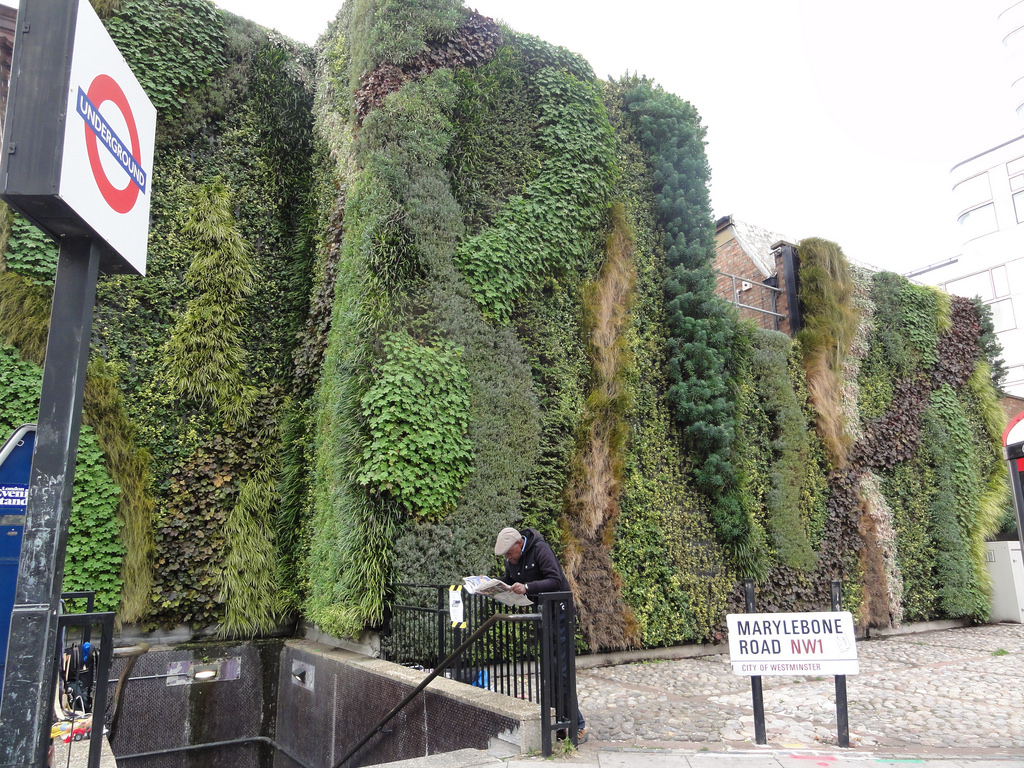
In 2011 a 180 m² living wall was erected at the entrance to the Edgware Road underground station, London, funded by the Department of Transport Clean Air Fund. The planting design (Figure 3) intentionally created a variety of textures across the wall to interrupt air flow and encourage particle deposition. The wall contains 14,000 plants of 15 different species which were planted in a matrix format with the same plants repeated at different heights within the wall to enable comparison of PM10 capture rates [5]. A study found a great disparity in the relative ability of different species. Plants with small leaves which are hairy, waxy or deep-veined were found to be more efficient than those with smooth and supple leaves. Convolvulus cneorum performed far better than any other species, followed by Stachys byzantina; Hedera helix was the worst performing species. Over the three month monitoring period, the total PM10 capture was calculated to be 515 g [6].
|
|
Another study involved free standing living walls at the Warren School in Dagenham, London, which is situated close to a busy road. A 15 metre living wall runs parallel to the road, and another living wall is situated at a 45° angle to it. The study looked at the effectiveness of five species (Stachys byzantina, Carex testacea, Convolvulus cneorum, Lavandula angustifolia and Geranium sp.) planted at three different heights (30 mm, 75 mm and 120 mm) at attenuating PM10. A comparison was also made between the two wall types and a nearby natural hedge. In parallel, the effect of the walls and hedge on nitrogen dioxide levels were also measured. All five species were found to capture particulate matter, but at low levels, which may have been due to high levels of precipitation recorded during the monitoring period. No significant difference was found in particulate capture between species or at different heights. However, the plants on the angled wall captured significantly more PM10 compared with the wall running parallel to the road. Previous studies have shown that wind flows around dense barriers are complex and this may have influenced the outcomes of this trial. The natural hedge assimilated a significant amount of nitrogen dioxide compared to the walls [7].
|
|

Living walls also have a role to play in the attenuation of noise pollution. While the hard surfaces of urban areas tend to reflect sound rather than absorb it, living walls can absorb sound: the vegetated surface will block high frequency sounds, and when constructed with a substrate or growing medium support they can also block low-frequency noises. Experimental studies have shown that even a thin layer of vegetation (20–30 cm) is able to absorb 1 dB of traffic noise, and 3 dB of pink noise.
|
|
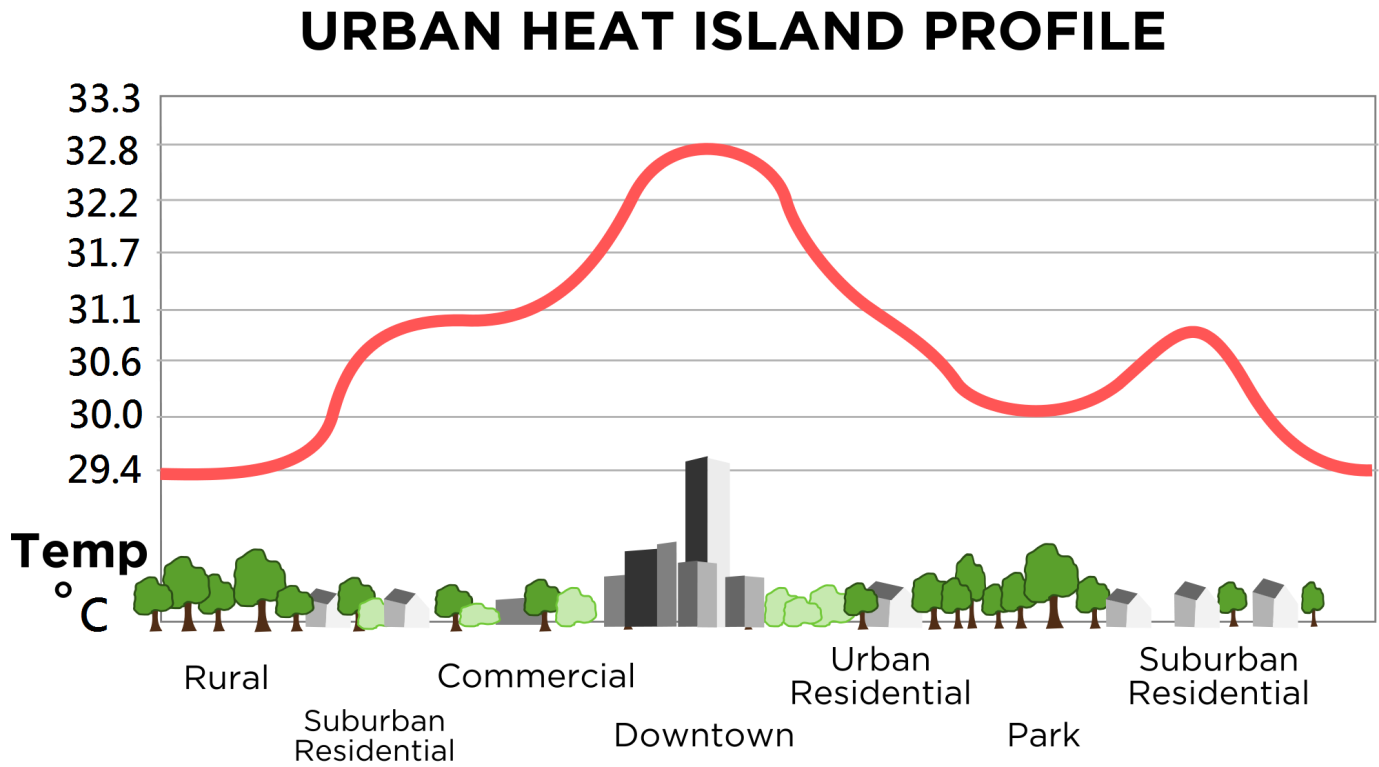
Green infrastructure can lower air temperatures through the evaporation of water from vegetation and by providing shading. Urban areas often experience elevated temperatures compared with the surrounding countryside, because of extensive heat absorbing surfaces, such as concrete and tarmac, concentrated heat production and impeded air flow. This is known as the ‘urban heat island effect’.
For example, the centre of London is on average 5°C warmer than surrounding rural areas. Heat waves during the summer pose significant health risks to urban populations either directly from the heat or from increased air pollution. During the 2003 heat wave, a temperature difference between urban and rural areas of up to 10°C was recorded for London and estimates suggest that 40% of the 600 excess deaths (the number of actual deaths minus the number of expected deaths) in London were due to the urban heat island effect. Climate change projections suggest that by 2050 such summer temperatures will be common.
Living walls can help reduce the urban heat island effect through the interception of both light and heat radiation which would otherwise be largely absorbed and converted to heat by the building surfaces and then radiated back into the surrounding streetscape. By providing shading from the sun, living walls can therefore significantly reduce the external temperature of a building. The effectiveness of this cooling effect is related primarily to the total area shaded and evapotranspiration effects of the vegetation, rather than the thickness of the living wall. Diurnal temperature fluctuations at the wall surface can be reduced from between 10°C and 60°C to between 5°C and 30°C. Other potential benefits of living walls include ‘bioshading’ – reducing sunlight penetration through windows. With strategic placement, the plants in living walls can also create enough turbulence to break vertical airflow, which slows and cools down the air.
Increasing plant species diversity and increasing the range of vegetation in cities can significantly increase other forms of biodiversity. Living walls can potentially provide a food source for invertebrates on which, in turn, other invertebrates and birds may feed. They also provide breeding and nesting habitat for invertebrates, birds and possibly bats, and are ideal for including artificial animal breeding structures such as nest boxes or bat roosting boxes. Careful choice of species and the orientation of the wall will increase the potential of a living wall to harbour other forms of wildlife. For example, ivy (Hedera helix) is a valuable food source for innumerable invertebrates which feed on its leaves, flowers and nectar, and, being evergreen, it also provides valuable over-wintering and hibernation habitat. In addition a living wall can be part of an overall city greening strategy linking ground level open space with street trees, water courses and living roofs.
Economic benefits
Green infrastructure can provide a competitive advantage to urban centres at a local scale through:
- Inward investment – attractive areas encourage the movement of employers to an area, and increase the value of local property.
- Visitor spending – attractive areas with green infrastructure attract more visitors, increasing spending with local businesses.
- Environmental cost-saving – green infrastructure can be a cost-effective alternative to grey infrastructure.
- Health improvement – where the provision of green infrastructure has a positive effect on the physical and mental health of local communities, it may reduce government spending on healthcare and improve workforce productivity (see unit 1.2.1.1 Health and wellbeing benefits).
- Job creation – green infrastructure can create jobs directly through activities involved with construction, maintenance or management, and indirectly through increased visitor spending. Green walls draw upon several disciplines for their design, installation and maintenance - such as landscape architects, architects, irrigation consultants, and so on. Demand for a local supply of plants and growing media creates further business activity.
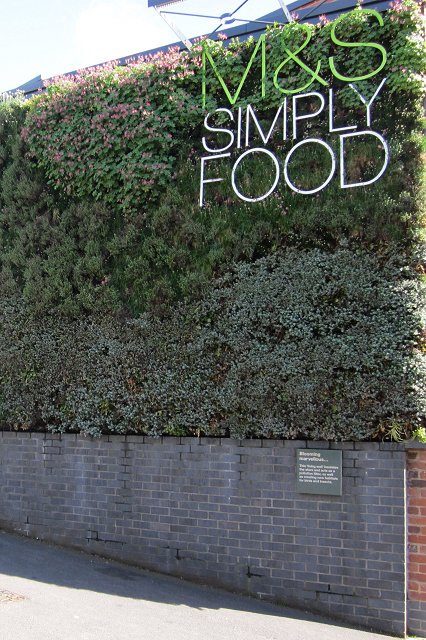
Living walls also provide economic benefits in terms of the building and its inhabitants. Contrary to received wisdom, climbers on buildings can actually help to protect the surface of the building from damage, particularly from very heavy driving rainfall and hail, and can possibly play some role in intercepting and temporarily holding water during rainstorms, in the way that green roofs do. Temperature fluctuations over a building's lifetime can be damaging to organic construction materials in building facades. Living walls provide an additional layer of exterior insulation and thereby limit thermal fluctuations. They also help to shield the surface from ultra-violet light, which might be an important consideration for certain modern cladding materials, and can increase the seal or air tightness of doors, windows, and cladding by decreasing the effect of wind pressure.
By reducing wall wetting, living walls can reduce the amount of cooling through evaporation at the wall’s surface, and therefore reduce energy loss through the building fabric. Living walls can also provide a certain amount of insulation, although the effectiveness of this will depend on the type and structure of the living wall and the overall energy performance of the building itself. Research has demonstrated that by creating a zone of still air adjacent to the wall, evergreen plants can reduce convection at the wall surface by up to 75 per cent and heating demand by up to 25 per cent. In general, the effectiveness of insulation is related to the thickness and coverage of plant growth. Living walls can help lower the air temperature around intake valves, which means HVAC units will require less energy to cool air before being circulated around a building.
Living walls are also a valuable marketing tool. Green buildings, products, and services now possess a competitive edge in the marketplace. Living walls are an easily identifiable symbol of the green building movement since they are visible and directly impact the amount of green space in urban centres. They are a strong visual support of corporate green strategies, and studies have shown that a company’s building may be viewed as a symbol of its environmental and social performance and may be an attraction for job candidates.
|
|
The benefits of internal living walls
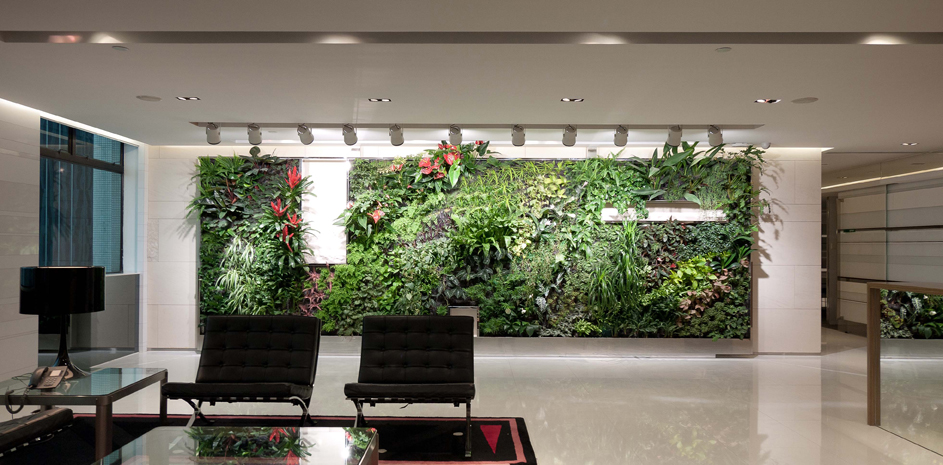
Indoor living walls have many benefits besides aesthetics, especially in the workplace. Through the process of photosynthesis, plants take in carbon dioxide (CO2) and release oxygen (O2). An increase in oxygen helps to keep us awake and alert. Studies show that plants naturally reduce our stress levels and make us feel more at ease in our surroundings. The presence of interior plants can increase productivity and inspire creativity amongst employees. Plants contribute to our overall wellbeing, which affects our mood, health and productivity. Positive moods, a part of wellbeing, are associated with enhanced learning and more efficient decision-making on complex tasks, greater use of logical reasoning techniques in problem solving, and higher benefits for all parties, and more innovative approaches, in negotiating. People working in a windowless room with indoor plants work more efficiently, are more attentive and have lower blood pressure than those working in the same room with the plants removed. A sense of wellbeing may also contribute to lower absenteeism in the workplace. Common areas utilizing plants, such as living walls, create spaces for employees to work together in collaborative groups. Plants also naturally absorb sound and soften noise pollution, so a living wall can be used effectively as a noise barrier in an acoustically loud space.
|
|

.png)

The average person spends over 90% of their time indoors, where we are constantly being bombarded with indoor air pollution. This includes toxic fumes such as formaldehyde, trichloroethylene, carbon monoxide, benzene, toluene, xylene, and other volatile organic compounds. Research undertaken by the National Aeronautics and Space Administration (NASA) has shown that chemicals such as formaldehyde and carbon monoxide can be removed from indoor environments by the plant leaves alone. Trichloroethylene, benzene, toluene, xylene and numerous other toxic chemicals can be removed by the roots of plant (or by the microorganisms living around the roots which degrade and assimilate these chemicals). This leads to fewer health complaints such as headaches and respiratory irritations, as well as increases in focus and attention. This process is significantly enhanced with bio-filtration living walls that integrate the wall into the heating, ventilation and air conditioning (HVAC) system. Biowalls are used strictly indoors and are often quite large. Air is pulled through the plants and growth media, into the HVAC system and the freshened air is redistributed throughout the building. These systems can be several stories high and are usually found in building atriums [8,
Certain tropical plant species are more efficient than others at filtering the air. The chart below lists toxic chemicals commonly found inside buildings, and a few examples of living wall plant which are most efficient at absorbing and neutralizing them.
Table 1: Toxic chemicals commonly found inside buildings and examples of plants which remove them
|
Common indoor toxic chemical |
Plants best at removing these toxins |
|
Formaldehyde (CH20) |
Peace lily (Spathiphyllum sp.) English ivy (Hedera helix) Boston fern (Nephrolepsis exaltata) |
|
Carbon monoxide (CO)
|
Spider plant (Chlorophytum comosum) Janet Craig Dracaena (Dracaena deremensis) Ficus sp. |
|
Volatile Organic Compounds (VOCs)
|
Golden pothos (Scindapsus aureus) Devil’s ivy (Epipremnum aureum) Philodendron sp. |
|
Trichloroethylene (TCE)
|
Mother-in-law’s tongue (Sansevieria trifasciata) Chrysanthemum (Chrysanthemum morifolium) Dracaena sp. |
|
Benzene (C6H6)/Toluene (C7H8)/Xylene (C8H10) |
Kimberley Queen Fern (Nephrolepsis obliterata) Orchid (Phalenopsis sp.) Dieffenbachia sp. |
.
Resources
- Green Capital: Green Infrastructure for a Future City
https://www.london.gov.uk/sites/default/files/green_capital.pdf
Case studies on the Rubens and St Mary’s Hospital living walls, London
- Green Capital — video
- Building a Green Infrastructure for Europe
http://ec.europa.eu/environment/nature/ecosystems/docs/green_infrastructure_broc.pdf
- The benefits of living green walls — video
- Delivering Vertical Greening
https://www.london.gov.uk/sites/default/files/2012-10-15_delivering_vertical_greening.pdf
- The role of shrubs and perennials in the capture and mitigation of particulate air pollution in London
- An investigation into the efficacy of green walls in reducing the levels of traffic pollutants PM10 and Nitrogen dioxide
http://www.lbbd.gov.uk/wp-content/uploads/2014/10/Alan-Nichols-Green-Wall-Dissertation.pdf
- Understanding the difference between a green vertical wall and a living wall biofilter
- Watermatic ‘Aerogation’ active green wall system — video
- Cleaning indoor air with Nedlaw living wall biofilters