Introduction to Vertical Greening Systems
Introduction to Vertical Greening Systems
Author:
Dr Sarah Milliken, University of Greenwich
1. Introduction
This unit provides an introduction to the course. It traces the historical development of vertical greening systems, including green facades and living walls. The benefits of vertical greening in external and internal environments are then discussed, including human health and wellbeing, and environmental and economic benefits. A brief summary of the difference between natural and artificial ecosystems highlights the importance of human intervention in order for living walls to thrive, in the form of water and nutrient supply, and the management of pests and diseases. These topics are covered in more detail in Unit 4. The different types of vertical greening system are then introduced, with a consideration of their relative sustainability in terms of their lifetime environmental costs. The unit concludes with a review of the different types of substrate and their appropriate use.
1.0 The historical development of vertical greening systems
Vertical greening systems are divided into two main categories: green facades and living walls. Green facades typically use climbers, such as ivy, which are planted in containers at ground level and which grow vertically on a building’s facade, either unsupported or on a system of wires or a trellis. Living walls, on the other hand, are modular panels comprised of polypropylene plastic containers or geotextile mats, and have vegetation planted throughout the surface of the wall. The two main types of living wall are hydroponic and media-based systems.
1.0.1 Green facades
In Germany there has long been a tradition of planting ivy on the facades of mills, which served as an additional insulation layer to cool the industrial machinery inside. In the early 20th century it became fashionable to grow climbers up the facades of buildings in order to make a seamless changeover between the house and garden. The use of green facades declined in the 1930s due to new building techniques and people’s concern about possible consequences on wall stability, only to remerge again in late 1970s Berlin, where species such as English ivy (Hedera helix) and Boston ivy (Parthenocissus tricuspidata) were planted throughout the city as a cost saving measure, since they obscured the stucco facades which otherwise would have needed to be regularly repainted. The recognition of the contribution of green facades to the ecological enhancement of cities in the early 1980s fuelled a widespread grassroots campaign for inner city greening, which in turn led to the development of incentive programs in about 35 German cities. 245,584 m² of green facades were installed between 1983 and 1997 in Berlin alone, where the Biotope Area Factor (BAF) was developed as an urban planning tool in order to improve ecosystem functionality and promote the development of biotopes in the city centre. The BAF puts into concrete terms the following environmental quality goals: safeguarding and improving the microclimate and atmospheric hygiene; safeguarding and developing soil function and water balance; creating and enhancing the quality of the plant and animal habitat; and improving the residential environment. The tool is designed to increase the amount of green spaces in new developments, by setting targets for the desired ratio between vegetated surfaces and the total site area, and allowing developers to select from a weighted menu that includes green roofs, vertical greening systems, and tree planting [1].
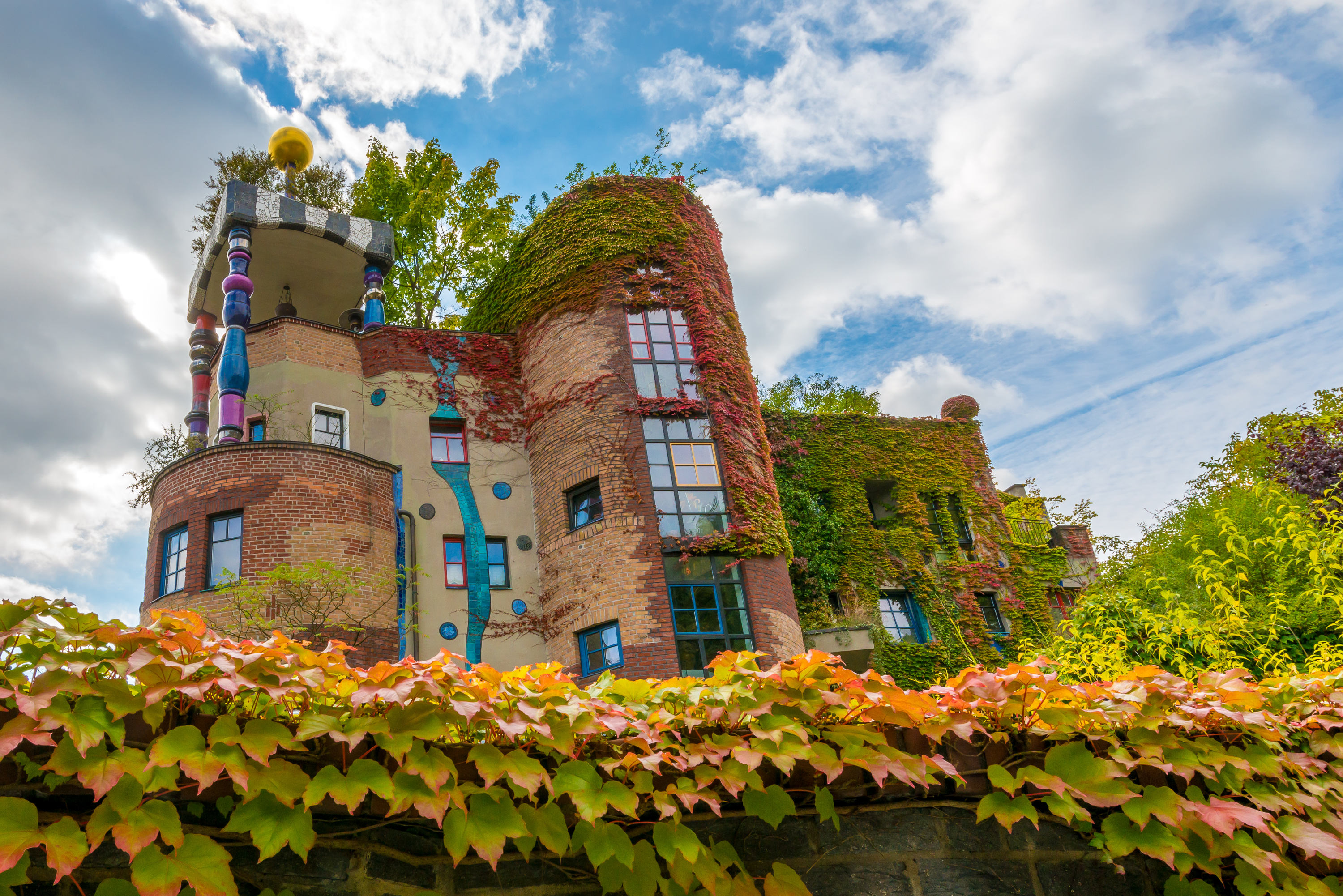
Some architects started to incorporate vegetated facades into their designs for new builds; perhaps the most iconic building of this period is the Hundertwasser House in Vienna, designed by Friedensreich Hundertwasser and built between 1983 and 1985 [2]. The stainless steel cable system for green facades was first introduced in 1988.

Figure 1: Hundertwasser House, Vienna
Source: https://upload.wikimedia.org/wikipedia/commons/b/b9/Hundertwasserhaus_Bad_Soden_Autumn.jpg
1.0.2 Living walls
The first living wall system was patented in 1938 by Professor Stanley Hart White, University of Illinois Urbana-Champaign (USA), who developed prototypes in his own garden. He named it the ‘Botanical Brick’. White envisioned that Botanical Bricks would stack like masonry, with meshes enclosing the plant growing substrate. White suggested that the substrate could be entirely inert through the use of building insulation as a growing medium. It appears that White therefore predicted the use of mineral wool in hydroponics, as the material was not actually used as a growing medium until the late 1960s when Grodan Rockwool® first became commercially available [3].
French tropical botanist Patrick Blanc developed the first geotextile living wall in the 1980s. His first 'mur végétal' was installed at the Cité des Sciences, Paris (FR) in 1986, and the system was patented two years later. The first commercial installations were in Paris, at the Pershing Hall Hotel in 2001, followed in 2005 by the Quai Branly Museum. Since then the Patrick Blanc system has been installed on or in hundreds of buildings on all five continents [4].

Figure 2: Quai Branly Museum, Paris (FR)
Source: https://www.flickr.com/photos/paolo_rosa/1349260571
Another landmark development in the technology of vertical greening systems took place at the University of Guelph in Toronto, Canada, where a team of researchers built and tested a biofilter, a hydroponic indoor living wall that acts as an air filter. This research, initially funded by NASA, evolved into a company by the name of Nedlaw. The system had its first commercial application at the University of Guelph Humber campus in 2005. The living wall is an integrated part of a building's air conditioning system. Air is actively forced through the wall of plants and highly specialized biological components actively degrade pollutants such as formaldehyde and benzene in the air into their benign constituents of water and carbon dioxide. The clean air is then distributed throughout the building [5].
The first modular system with plastic containers was patented at the beginning of the 21st century. Since then a wide range of designs of both modular and geotextile systems has been produced in different countries around the world. Some of these will be explored in more detail in unit 1.4. The number of companies designing and installing living wall system has also increased exponentially over the past two decades. This is partly in response to the promotion of living walls in urban planning best practice guidance in many European cities, such as the Biotope Area Factor in Berlin, the Green Space Factor and Green Points System in Malmö [6], and the Living Roofs and Walls Policy in London [7]. Alongside these policies aimed at new developments, there have also been initiatives involving the retrofitting of living walls onto existing buildings in order to improve the quality of life of both humans and wildlife in cities. 1012 m² of living wall was installed in London financed by the Mayor’s Air Quality Fund (2013-2016) [8], and more than 100 vertical greening systems have been installed in different quarters of Paris as part of a sustainable city policy over the past three decades. In 2014 the Mayor of Paris committed a further €2,000,000 to Des Jardins sur les Murs (Gardens on the Walls), part of the Végétalisons la Ville (Revegetate the City) initiative (2014-2020). The project involves the creation of 41 vertical greening systems (green facades and living walls) in order to create wildlife corridors linking open green spaces such as parks and gardens, and to improve air quality and microclimate [9, 10]. Some European governments have also started to promote living walls in their national laws, such as Italy’s Legge 14 gennaio 2013, no. 10 ‘Norme per lo sviluppo degli spazi verdi urbani’ (Law 14 January 2013, no. 10 ‘Standards for the development of urban green spaces’) which identifies the importance of vegetation for the environment, and therefore the need to increase and to develop public and private green areas, including the use of vertical greening systems [11].
Alongside the development of new types of geotextile and plastic container living wall systems (see unit 1.4 for a discussion of various examples), innovative systems are being developed which incorporate new types of materials. For example, Creabeton Matériaux SA (CH) has developed the Skyflor system which has modular elements consisting of a thin, porous ceramic surface which allows plant roots to penetrate and the substrate to breathe. The panels are backed by a thin layer of fibre-reinforced ultra-high performance concrete which ensures minimal thickness and weight. The gap between the ceramic surface and the concrete back is filled with substrate which has been formulated for optimal plant growth. The surfaces of the panels are sown with seeds to suit the requirements of the client and the local environment, and have been shown to provide a highly absorbent sound-screen. Skyflor is an award winning patented system: Creabeton Matériaux SA were awarded both the Gold Medal in the Construction/Architecture category and the Young Entrepreneur prize at the 38th International Exhibition of Inventions in Geneva in 2010 [12].

Figure 3: Skyflor by Creabeton Matériaux SA
Source: www.skyflor.ch
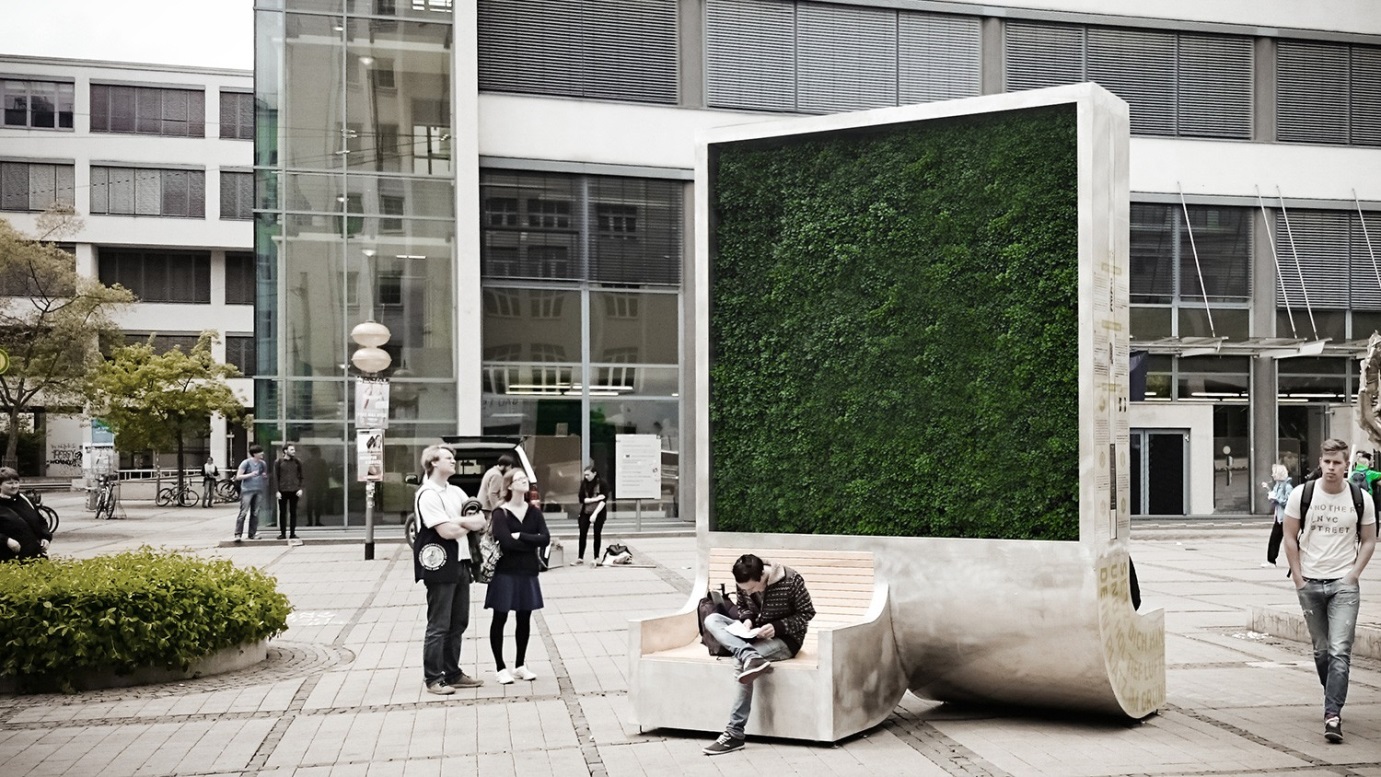
Another example of an innovative living wall system is CityTree by Green Living Solutions (DE). Planted with moss to filter fine dust, nitrogen oxides and therefore a large amount of CO2 equivalents out of the air, each unit is said to be as effective in combating air pollution as 275 urban trees at 5 % of the cost and requiring 99 % less space. The units have a solar-powered automated irrigation system which delivers nutrients to the plants. Integrated Internet of Things (IoT) technology collects, analyses and visualises data about the status and environmental performance of the CityTree [13].
|
|

The Royal Horticultural Society (RHS) has produced a useful online summary of living walls, including the different types, their benefits, and suitable plants [14].
Resources
- Biotope Area Factor (BAF), Berlin http://www.stadtentwicklung.berlin.de/umwelt/landschaftsplanung/bff/index_en.shtml
- Hundertwasser House, Vienna
http://www.hundertwasser-haus.info/en/ - Stanley Hart White's 'Botanical Brick'
http://horticulturalbuildingsystems.com/wp-content/uploads/2012/04/a-vertical.pdf - Patrick Blanc
http://www.verticalgardenpatrickblanc.com/ - Nedlaw living wall biofilter
http://www.nedlawlivingwalls.com/ - Green Space Factor and Green Points System, Malmö
http://www.malmö.se/download/18.d8bc6b31373089f7d980008924/1383649554866/greenspacefactor_greenpoints_grabs.pdf - Green Roofs and Walls Policy, London
https://www.london.gov.uk/sites/default/files/living-roofs.pdf - Mayor’s Air Quality Fund, London
https://www.london.gov.uk/sites/default/files/mayors_air_quality_fund_report_2016.pdf - Des Jardins sur les Murs, Paris
https://budgetparticipatif.paris.fr/bp/jsp/site/Portal.jsp?document_id=2206&portlet_id=158 - Végétalisons la Ville, Paris
http://www.paris.fr/duvertpresdechezmoi - Norme per lo sviluppo degli spazi verdi urbani (Legge 14 gennaio 2013, no.10)
http://www.minambiente.it/sites/default/files/archivio/normativa/legge_14_01_2013_10.pdf - Skyflor by Creabeton Matériaux SA
http://www.skyflor.ch/en/home/ - Green City Solutions CityTree
https://greencitysolutions.de/en/ - RHS green walls
https://www.rhs.org.uk/advice/profile?PID=547