PROJECT WORKFILE:
LINGUISTIC AND INTERCULTURAL AWARNESS
Authors:
Sarah Horstmanshoff and Monika Stržinar
Mentor:
Mateja Dagarin Fojkar
Ljubljana, 2023
INTRODUCTION
The topic we have chosen for our presentation was ‘Comparison of the republic of Slovenia and The Netherlands’. Since we know our countries best, we thought this was the best way to include both of our countries and compare some facts about them.
We chose four different subtopics for the countries: general information, dishes, national costumes and traditions. One of the main goals for our presentation was to keep our classmates active and motivated and we believe that goal was achieved.
We included 3 main activities in the presentation which were adapted for older people but can easily be used with young learners. Two of those activities are described below.
A COLLECTION OF ACTIVITIES
Songs
To compare the Netherlands and Slovenia in another way we look at music. Eurovision took place in May 2023 and because of that we will take a look at songs from both countries. As teachers, we could print out the lyrics and leave a few words out. The students have to fill out the blanks while listening to the song. After this the students could talk to each other about which song they prefer.
Slovenia - https://eurovisionworld.com/eurovision/2023/slovenia
The Netherlands - https://eurovisionworld.com/eurovision/2023/netherlands
Maps
The students get one blank map of Slovenia and one of the Netherlands. Both of the blank maps contain numbers. With the help of the internet, they can figure out which city or river belongs to what number.
Slovenia - https://www.mapsland.com/europe/slovenia/large-map-of-slovenia-with-regions-roads-railroads-major-cities-and-airports
The Netherlands - https://www.mapsland.com/europe/netherlands/large-political-and-administrative-map-of-netherlands
Sayings
The students will practice some sayings in Slovenian and Dutch in pairs. In the ideal situation a Slovenian student would work with an international student. After ten minutes of practicing everybody pronouns their saying in front of the class and explain the meaning.
Slovenia - https://www.lingalot.com/slovenian-quotes/
The Netherlands - https://kunst-en-cultuur.infonu.nl/taal/2730-bekende-nederlandse-spreekwoorden-en-gezegdes.html
Celebrities
The students work in pairs and each pair gets a photo of a famous Dutch or Slovenian person. They need to figure out who this person is and what their connection to the country is.
Slovenia - https://www.thefamouspeople.com/slovenia.php
The Netherlands - https://www.thefamouspeople.com/netherlands.php
Statements
True of false statements, which could be going about certain customs or habits in Slovenia and the Netherlands. The children lift up their right hand if they think the statement is true and left hand if they think is false.
TWO ACTIVITIES FOR CHILDREN
Activity 1: Matching pictures with the right words
Name of the activity:
Connecting food pictures with the right words.
Aim of the activity:
Connecting pictures with matching names.
Reading the names and finding the meanings or connections with their first language.
Age of learners:
9 years
Approximate length of the activity:
10—15 minutes
Description of the activity:
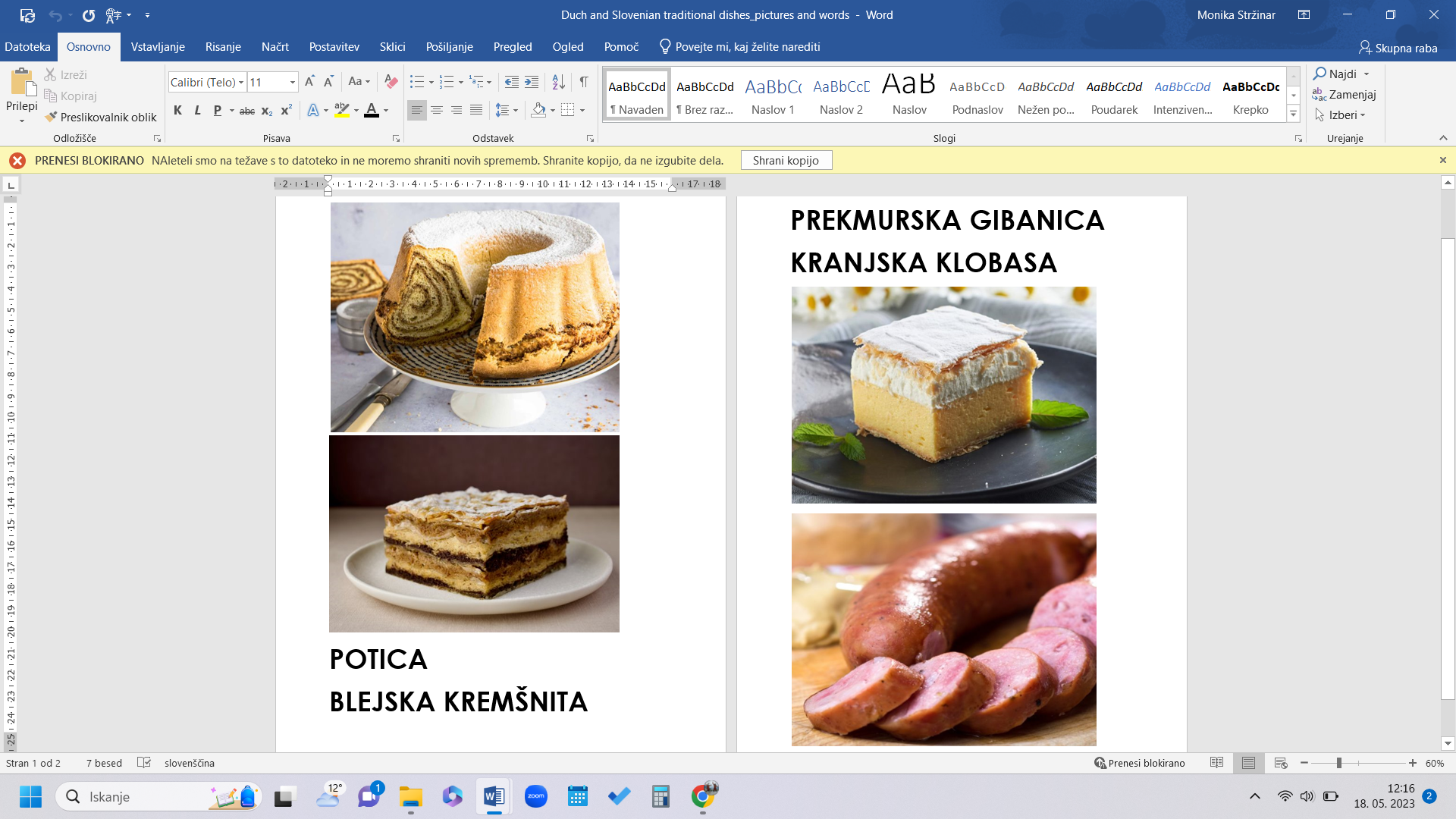
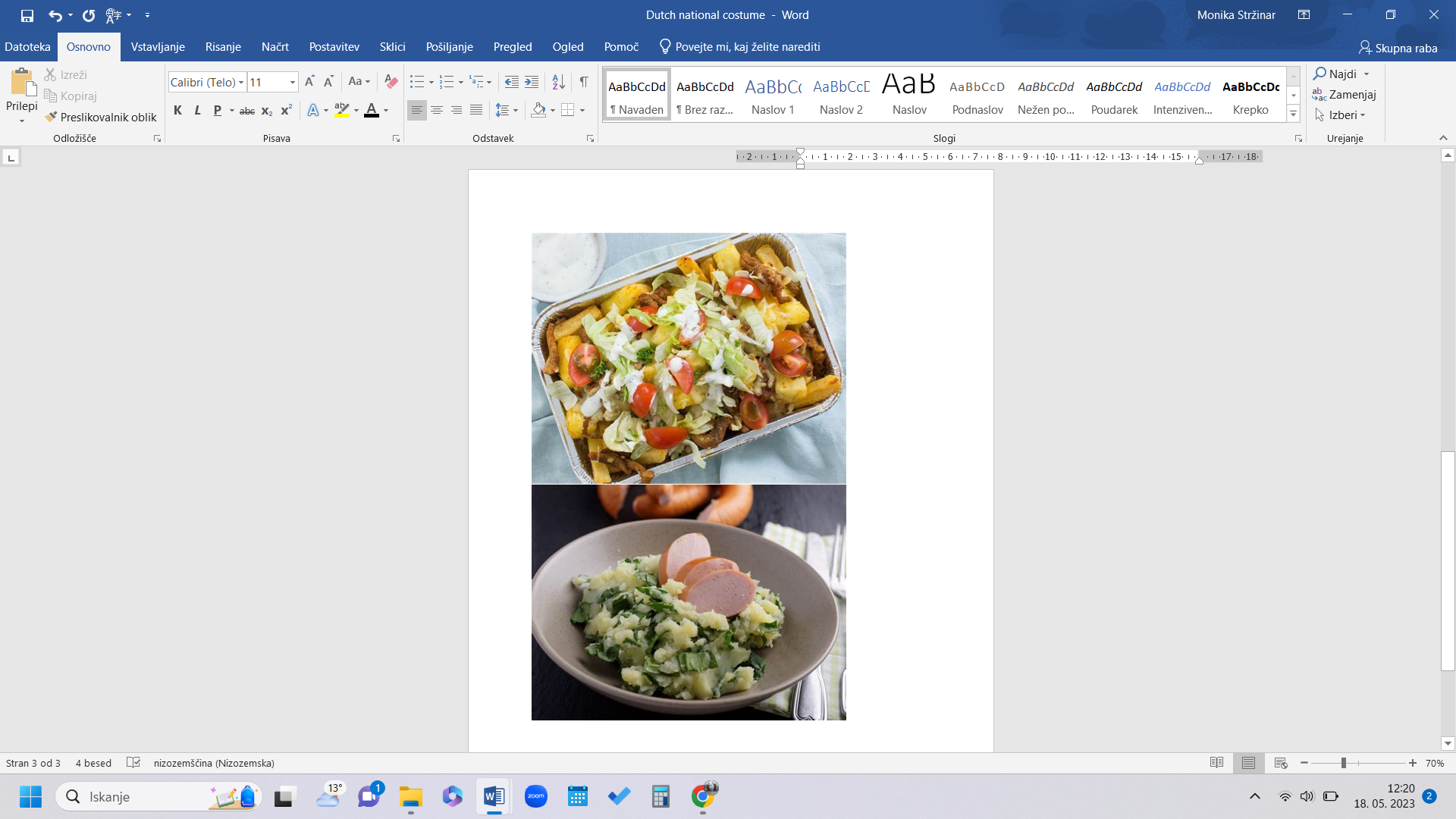
We divide children into smaller groups or pairs, depending on number of children. Each group gets a packet which contains pictures of different foods from Slovenia and The Netherlands and words which are the names of the food. The children have to match the pictures with the right words. After some time, we check their solutions with the help of PowerPoint presentation.
Language level of learners:
A1
Skills practised (listening/speaking/reading/writing):
Listening, speaking, reading
Vocabulary practised:
Listen carefully.
Match the pictures with words.
Make groups of (three, four ..)/make pairs.
Food vocabulary.
Materials needed:
Food pictures and names.
Cross – curricular links: /
FREPA/CARAP descriptors: (see pages 24 to 59 of the FREPA document https://www.ecml.at/Portals/1/documents/ECML-resources/CARAP-EN.pdf?ver=2018-03-20-120658-443
How the activity develops intercultural awareness:
Children learn about Slovenian and Dutch dishes and they learn the right pronunciation about foods. Children learn about certain dishes that can be connected to cultural aspect.
Classroom organisation (group work, pair work, whole-class …):
Group work/pair work
Possible pre- and post- activities:
Pre-activity could be a brief description of eating habits of both countries.
Post-activity could be fining the recipe for one of the dishes and presenting it to the class.
Variations (if there are any):
Instead of the names of dishes we could have the preparation of the dishes.
Additional notes (if applicable): /
Activity 2: Dress the doll
Name of the activity:
Dress the doll.
Aim of the activity:
Dressing the Slovenian/Dutch doll in a correct order or way.
Learning about various layers in traditional Slovenian and Dutch women’s costumes.
Age of learners:
9 years
Approximate length of the activity:
10—15 minutes
Description of the activity:
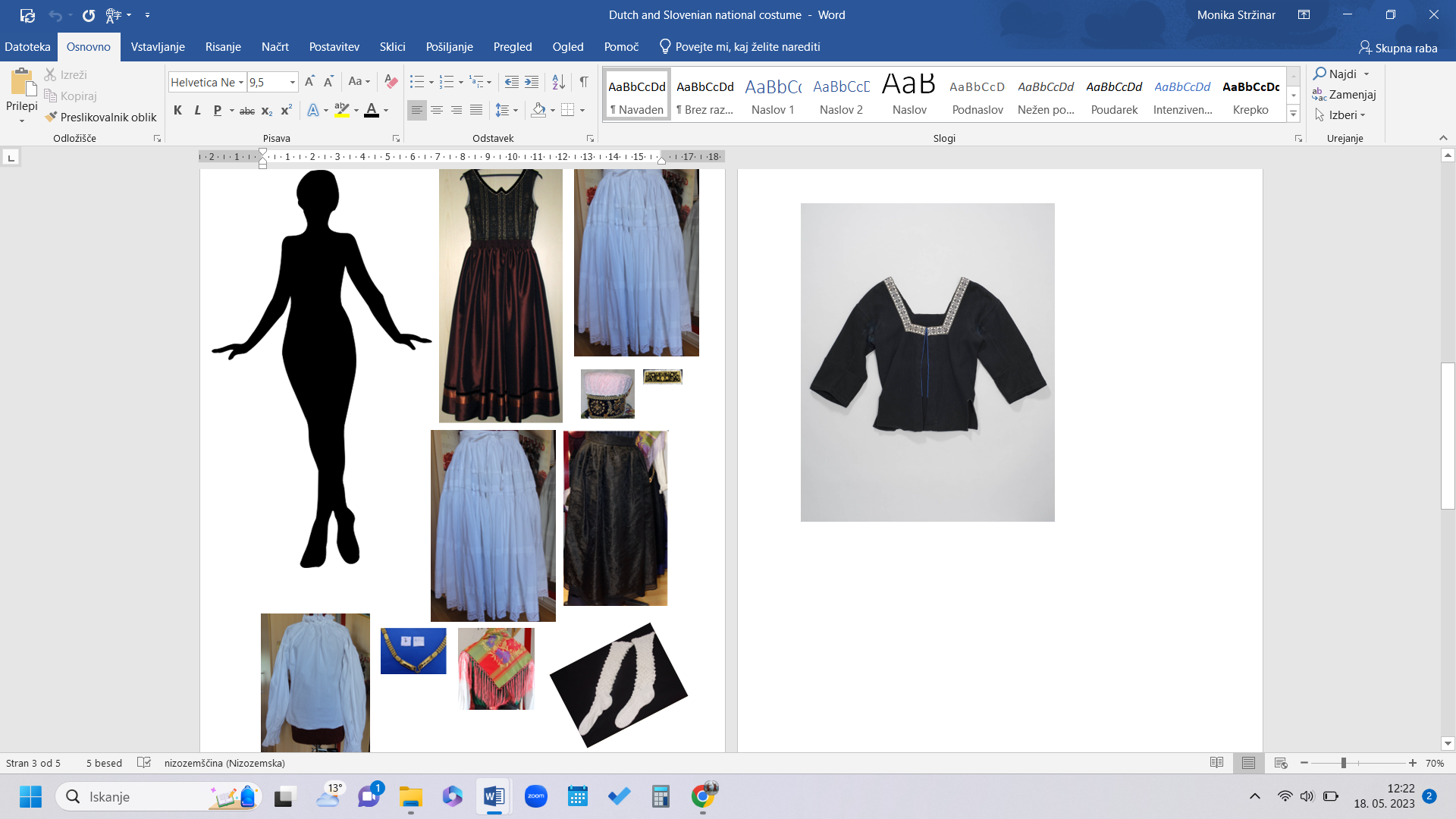
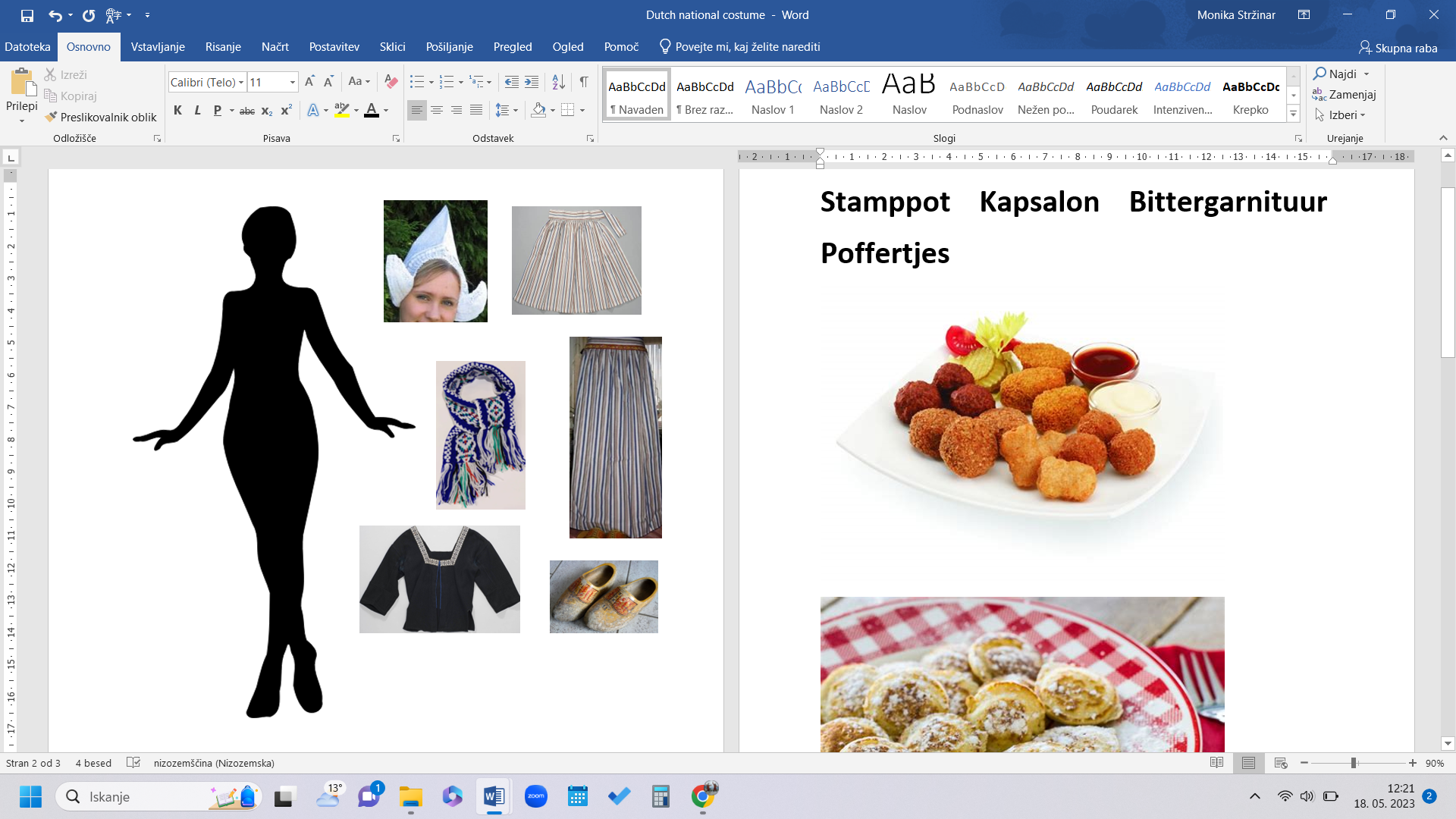
We divide children into smaller groups or pairs, depending on number of children. Each group gets a packet which contains one woman’s silhouette and costume’s different layers. The children have to arrange the layers as they think it is correct. After some time, we ask a couple of groups for their feedback and the way they dressed their doll. In the end we show the right way with the help of PowerPoint presentation where we also dress the doll correctly and also tell the names of different clothing pieces. We can also explain some hidden meaning behind certain layers.
Language level of learners:
A1
Skills practised (listening/speaking/reading/writing):
Listening, speaking, reading
Vocabulary practised:
Listen carefully.
Make groups of (three, four …)/make pairs.
Put the clothing pieces on the doll.
Clothes vocabulary.
Materials needed:
Doll silhouette cut out and clothing pieces.
Cross – curricular links: /
FREPA/CARAP descriptors: (see pages 24 to 59 of the FREPA document https://www.ecml.at/Portals/1/documents/ECML-resources/CARAP-EN.pdf?ver=2018-03-20-120658-443
How the activity develops intercultural awareness:
Children learn about national costumes in the Netherlands and Slovenia. They are connected to cultural values, history and certain regions of the countries.
Classroom organisation (group work, pair work, whole-class …):
Group work/pair work
Possible pre- and post- activities:
Pre-activity could be a brief historic description of the traditional costumes and the meaning behind it.
Post-activity could be comparing the two national costumes in groups – what are the differences and the similarities.
Variations (if there are any): /
Additional notes (if applicable): /
LESSON PLAN
|
SPROTNA PRIPRAVA na vzgojno-izobraževalno delo | |
|
OŠ: / Učiteljici: Sarah Horstmanshoff, Monika Stržinar | |
|
PREDMET: English RAZRED: 4th UČBENIŠKI KOMPLET: / | |
|
ZAPOREDNA URA: / DATUM REALIZACIJE: / | |
|
TEMATSKI SKLOP: Countries | |
|
UČNA TEMA / ENOTA: The Netherlands vs. Slovenia | |
|
UČNI CILJI: (goals of the lesson)
| |
|
UČNA METODA:
|
UČNA OBLIKA: - pair work, group work
|
|
DIDAKTIČNI PRIPOMOČKI: computer, black board, food pictures and words, doll cutout and clothing, laminated white paper and pens | |
|
MEDPREDMETNA POVEZAVA: /
| |
|
UVOD We introduce ourselves and start by telling some facts about the Netherlands and Slovenia. We tell the students about expectations of this lesson (APPENDIX 1).
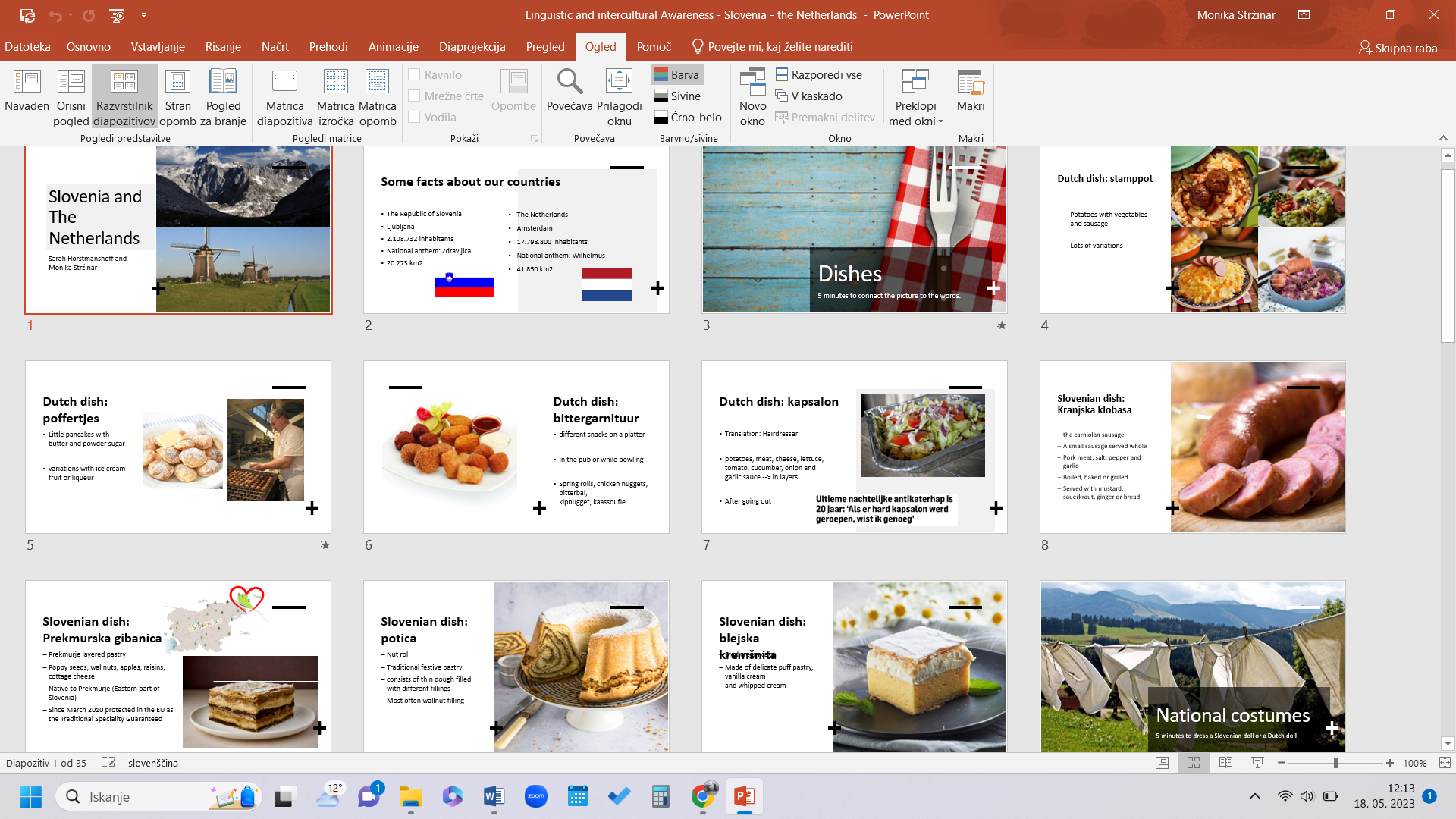
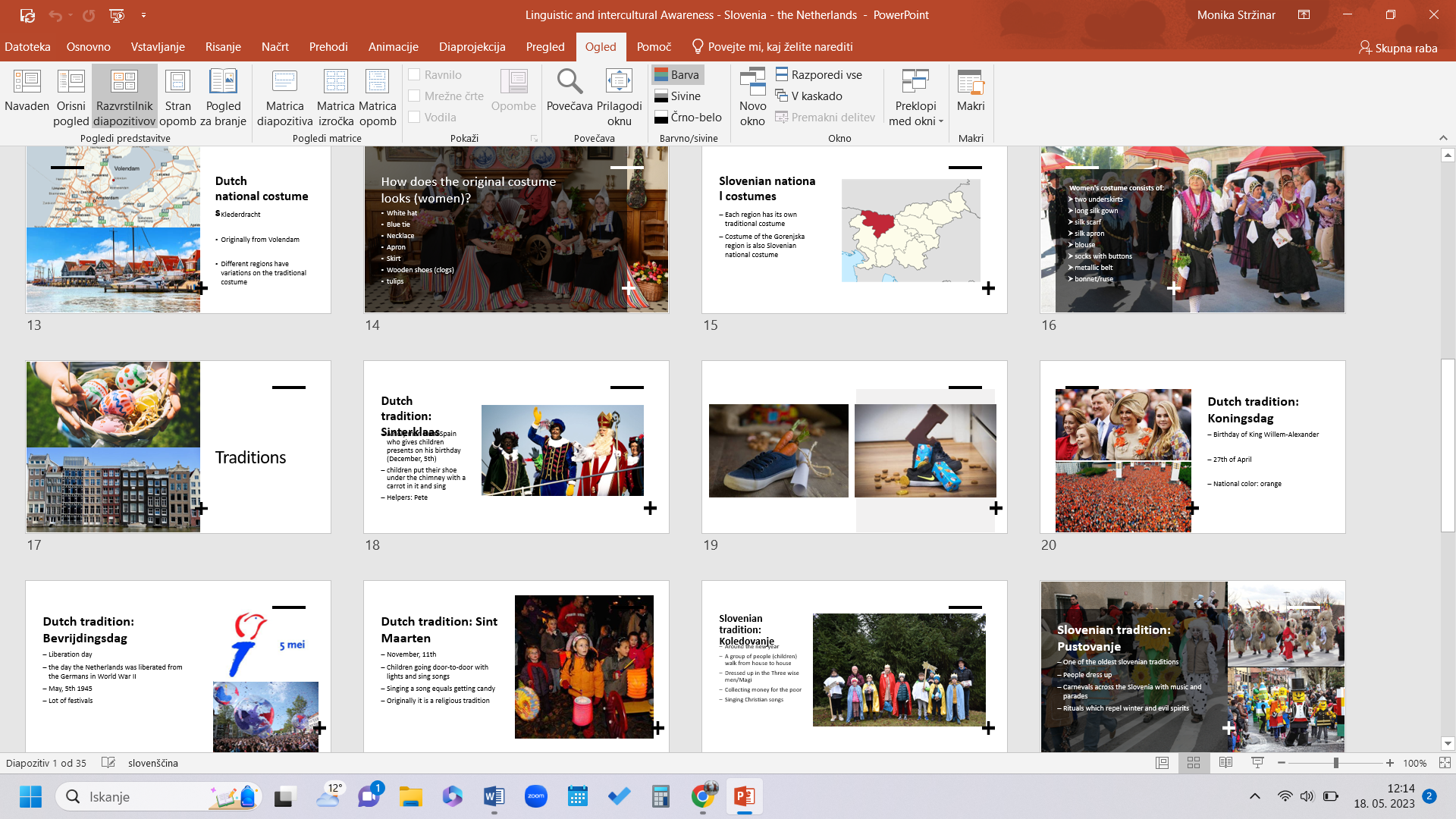
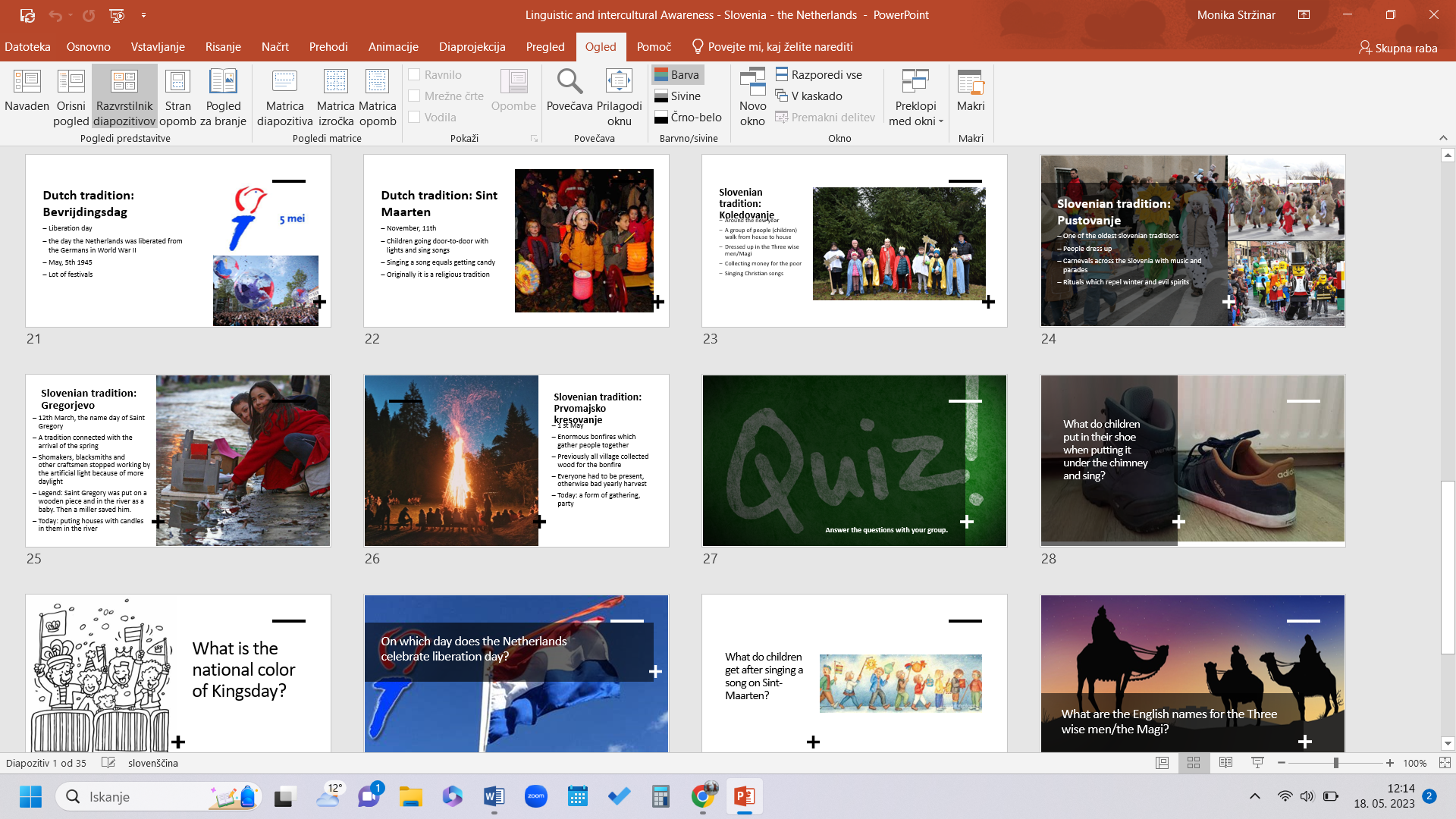
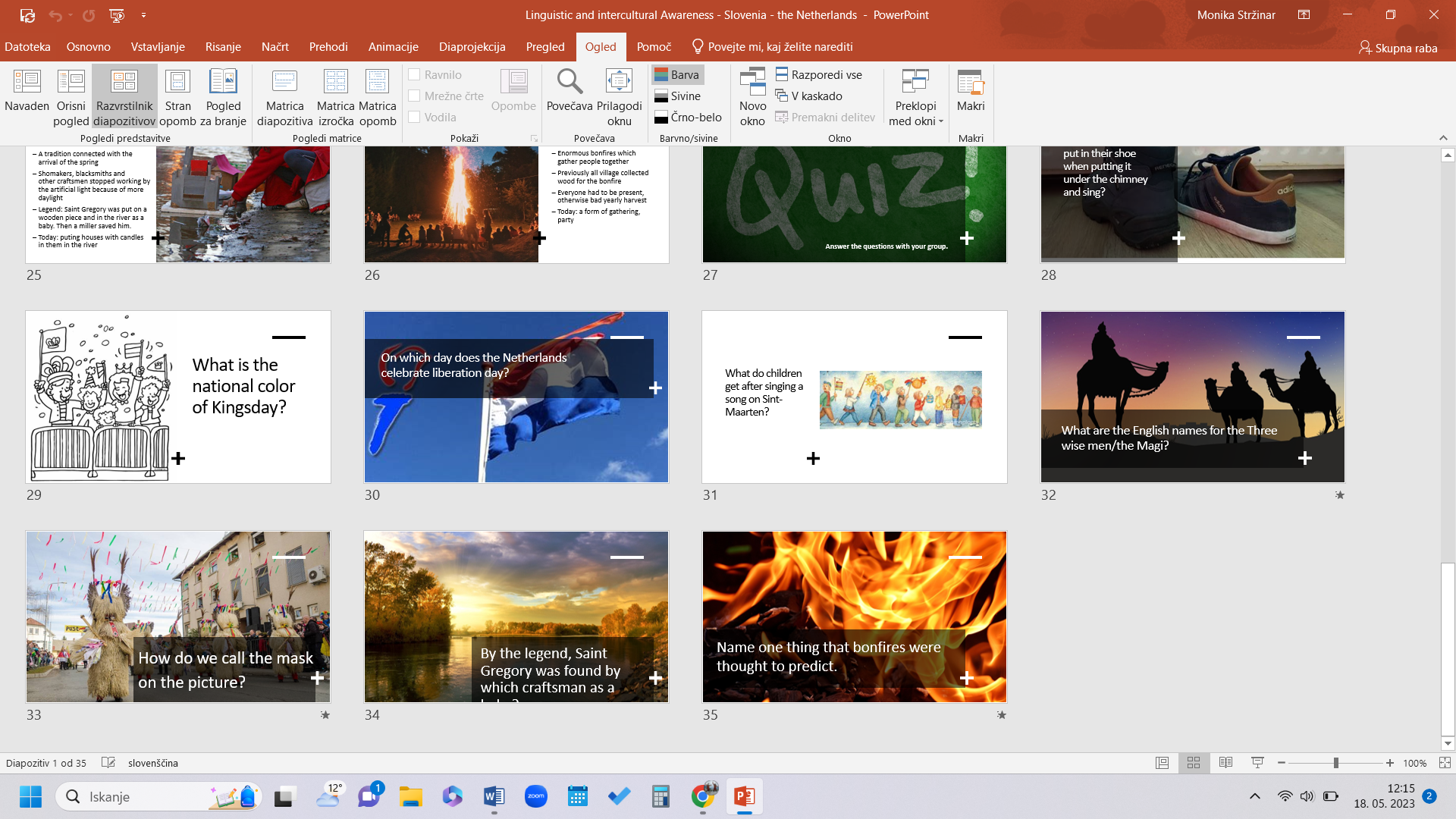
UČENJE We tell the children about three subtopics we chose for today. Activity 1 We start with Food. We divide children into pairs and explain them the rules of the activity: “Each pair will get some pictures and words (APPENDIX 2). Your job is to try to connect the words with the right picture of foods. When you finish we will check your guesses.” When they are finished we check their guesses and also give them some explanations about the dishes with the help of PowerPoint presentation (APPENDIX 1). Activity 2 We continue with national costumes. Children stay in pairs. “Each pair will get one doll silhouette and clothing (APPENDIX 3). You have to dress the doll and be careful about different layers of clothing. When you finish we will check how it went.” When they are finished we check their guesses and also give them some explanations about the national costumes with the help of PowerPoint presentation (APPENDIX 1). Activity 3 We continue with a presentation about Dutch and Slovenian traditions (APPENDIX 1). “You have to listen very carefully, because after that we will play a quiz based on this.” We explain the traditions with the help of our PowerPoint presentation and after that we give each pair one laminated white paper and a pen. They have to write their answers on the laminated paper.
ZAKLJUČEK At the end we ask children how they liked the lesson: “Which activity was your favourite? If you like the first one the most hold up one finger, if you liked the second one the most, hold up two finger and if you like the last one the most hold up three fingers.” | |
APPENDIX:
APPENDIX 1 (PowerPoint presentation):
APPENDIX 2 (Food pictures and words):
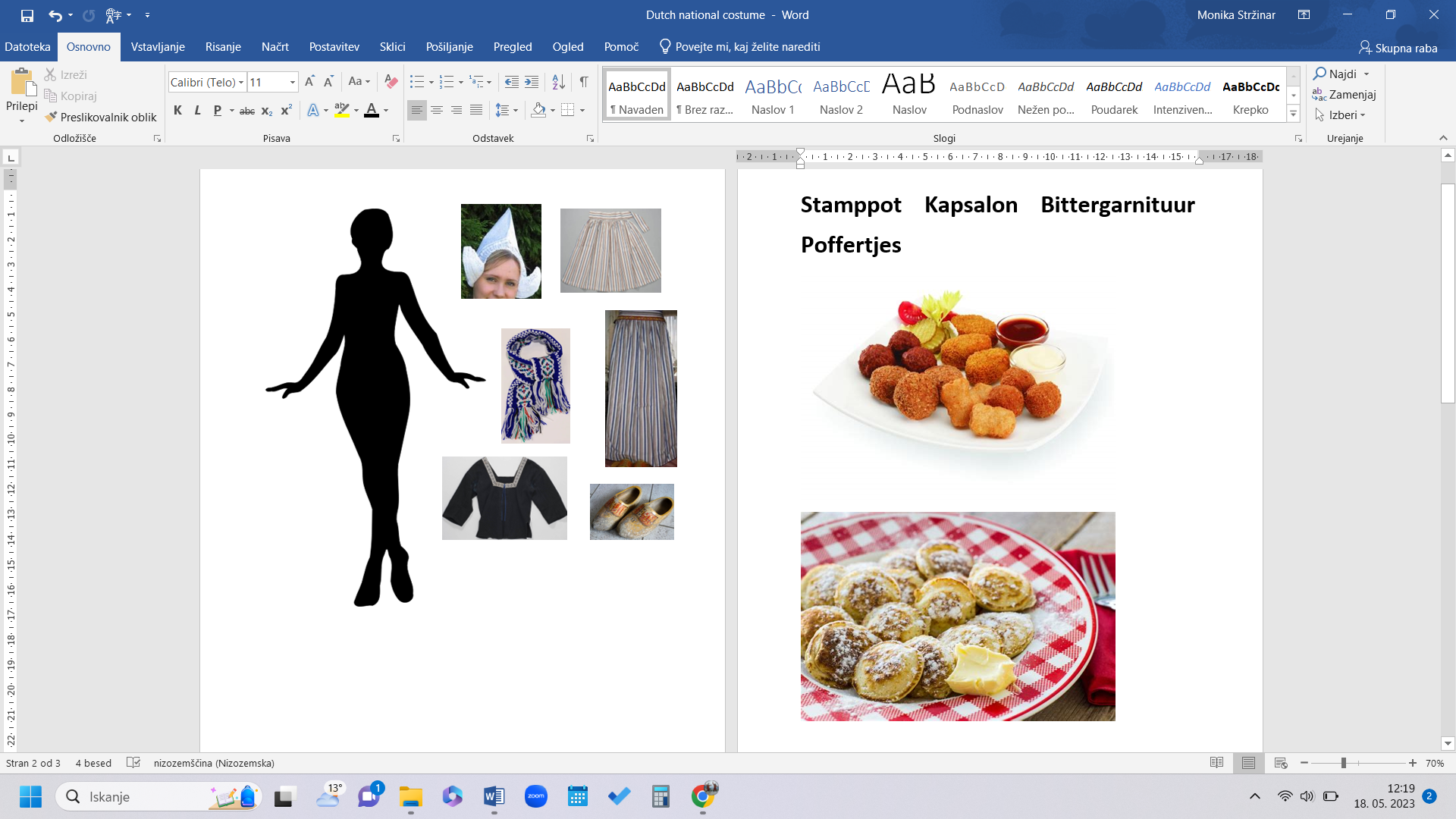
APPENDIX 3 (Doll silhouette and clothing):